Uncategorized
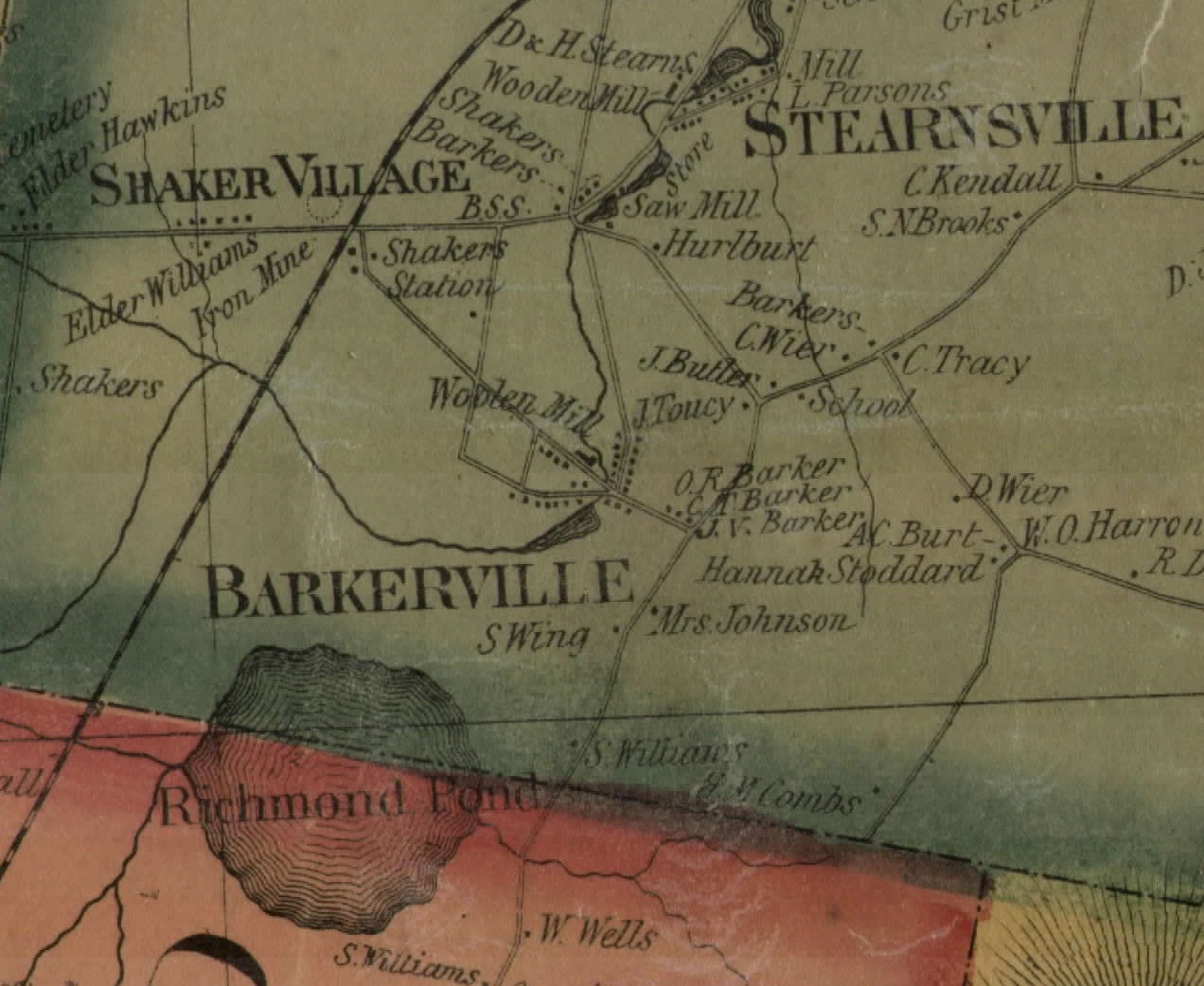
Richmond Pond
Richmond Pond was formed as a small 98 acre body of water that was scraped from the bedrock by glaciers thousands of years ago. Four tributaries brought fresh mountain water into the pond which was also spring fed.
A natural outlet on the northern side of the pond flowed into the Southwest Branch of the Housatonic River. Charles Goodrich was the original owner of the Pond and the land near the outlet. By 1768 sawmills, grist mills and fulling mills began to be erected on the river. One of these was the Fulling Mill of Valentine Rathbun.
In 1803 Daniel Stearns purchased the Rathbun mill and began the period of growth that led to Stearnsville, Barkerville, Tillotsons and the Shaker Grist Mill.
The mill owners and the Shakers acted as partners rather than competitors, and in 1838, 1864 and 1876 built new dams and outlets at the pond. They also worked together to repair the dam when storms caused damage.
The water level was raised by 9 feet which increased the power available and provided reserves in times of low water levels. Thus a small 98 acre glacial pond was increased in size to a reservoir of 218 acres with a depth of fifty-three feet.
The Barker family purchased the 135 acre site around the outlet in 1832. The family made many improvements to their mill and maintained the outlet and dam.
After their bankruptcy in 1890, ownership eventually went to the Barkerville Realty Trust managed by two local men: Owen Coogan and Frank Pierson. Mr. Pierson was a Boy Scout leader and the land was used for a summer camp for the Scouts from 1916-1929. Local Girl Scouts also used the camp.
In 1933 the Realty Trust sold the land, including the outlet and dam, to Sarah Moss of New York City. She opened Camp Allegro, a Jewish summer camp for girls ages 5-14. The camp opened in 1934 and many improvements were made to the buildings and to the dam. The major work on the dam was in 1950 when two storms struck the area and the dam was breached. The water level in Richmond Pond dropped three to four feet overnight and there was flooding down river. In 1977 the property was sold to the Northeast Baptist Conference which founded the Lakeside Christian Camp in 1980. The owners erected many new buildings and the infrastructure to remain open year round. Summer camping continued and there were retreats available for many different congregations. The camp was open for 40 years but finally closed in April, 2020.
Osceola Park and Why Osceola in Pittsfield?
Osceola is perhaps the only park in Pittsfield that has a direct historical connection to a former mill
village. The Tillotson family was generous in providing public use of the future park land. In 1868 they donated
an area to the city for the establishment of the Osceola School which would serve neighborhood children until 1940. By the 1880’s the park was used as a public baseball, athletic field and ski area.
After the bankruptcy of Tillotson’s Mill in 1931, the land was purchased by the Pittsfield Industrial Development Company and eventually was donated to the City in 1942.
Osceola – Seminole Chief in Pittsfield?
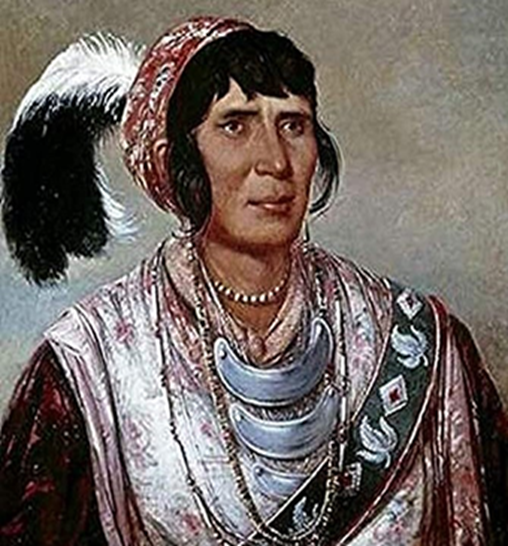
A young brave named Osceola became a leader of the tribe and gained national fame as a noble warrior who fought for the rights of his people. He was featured in books, songs, and poems. Osceola was arrested at a truce conference and died in a federal prison In 1838. Many towns, counties, and other landmarks across the country were named in his honor. Two were local: Osceola Mountain in Richmond, Massachusetts and Osceola Mountain at the site of the future Bousquet Ski Area in Pittsfield.
It is believed that the name for the mountains was chosen by Rev. Henry Colman, the Commissioner of Agriculture for the State of Massachusetts from 1836-42. In his 1838 study of Berkshire County, Colman writes that iron ore was found in Richmond “near the highlands designated as Mount Osceola”. That was the year of the death of Osceola, so it seems likely that the mountains were chosen as a memorial. An 1879 article in the Berkshire County Eagle also credits Rev. Colman as the person who originated the name.
A history of that time notes that the Tillotson Mill was situated “near the foot of Osceola Mountain”. A 1954 map of the Bousquet’s Ski Area in Pittsfield clearly locates Osceola Mountain as the high point of that region.
To this day, if you gaze south from the mill on West Housatonic St., Bousquet’s and the mountain, now called Osceola Mountain, are clearly visible.
Barkerville Mission Chapel
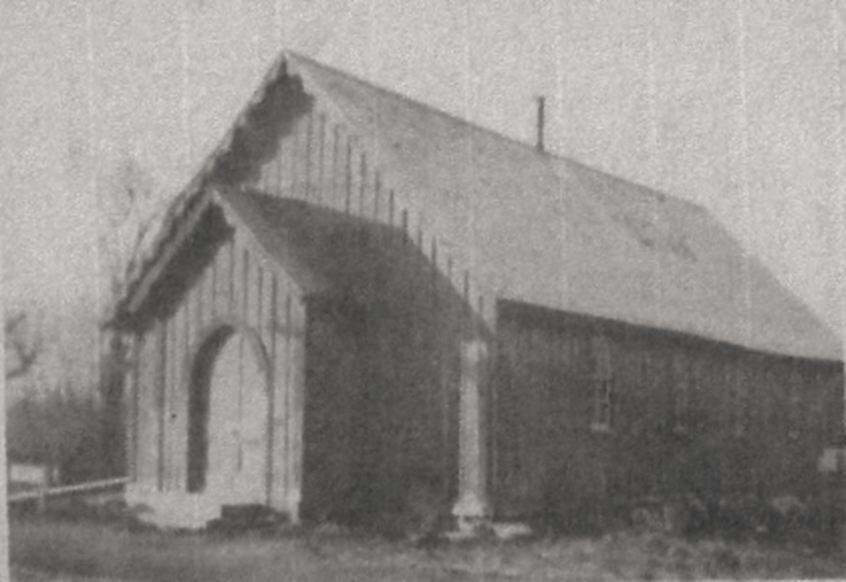
On the banks of Southwest Branch of the Housatonic River lies the educational and research center of the Berkshire Environmental Action Team (BEAT), an advocacy group in the county. In 1867, though, it was built to serve as a mission of St. Stephen’s Church on Park Square in Pittsfield. Funding was provided by local residents and a gift from the Emmanuel Church in Boston MA.
In 1885, the Crystal Stream Sons of Temperance society acquired the building and renovated it for their meetings. It was also used for regular religious services and social events for the community.
In 1909, a local church group began using the building and in 1913 incorporated as Immanuel Community Church. Over the years several additions were completed and the building moved to a new foundation.
When the church closed, BEAT rented the building in 2019 and purchased it in 2022. They are in the process of converting to zero net energy and outdoor improvements such as a spring ephemeral garden, pollinator meadows and a rain garden. A new life for an old building.
Shaker Grist Mill
The Hancock Shaker Village was founded in 1790 and by the middle of the nineteenth century had grown to include over 3000 acres and 300 members.
Most of the Central or “Church” Family was located in the town of Hancock, but there were also several outlying families within the city limits of Pittsfield. The East Family lived along West Housatonic St. and also on Lebanon Ave. near the junction of Melbourne Avenue and the Southwest Branch of the Housatonic River.
In 1823 the Shakers purchased a former mill site on the river and erected a grist mill for processing grain. Although originally bult for their own purposes, it was improved and enlarged in 1850 and 1867 and became open to the community and was one of the largest grist mills in all of Berkshire County.
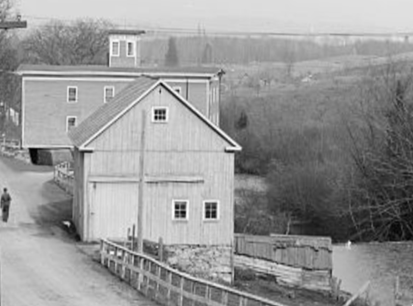
Shaker Grist Mill on Lebanon Avenue- View from West
On April 7, 1915 a fire, likely arson, broke out at the mill and it was burned to the stone foundations. The replacement cost was thought to be $12,000 and Shaker Elder Joseph Holden stated that there was no insurance and no money to rebuild.
Miraculously, the Shakers and the local community worked together and a new mill building was erected on the old foundation.
Nearby residents, Romeo Coty and his brother Seymour were previous managers of the mill and they leased the property from the Shakers. The mill reopened on June 14, 1915 only nine weeks after it had burned.
The Coty Brothers and other companies leased the mill until 1925 when it was finally closed and eventually torn down. Remnants of the mill dam and foundation, almost 15 feet high, are still present in the river.
Barkerville Mill Village
In 1832, John and Charles Barker purchased the original 1804 mill of Daniel Stearns. Two years later, brother Otis joined the firm which was then named John V. Barker and Brothers.
In 1842, the Western Railroad, later the Boston and Albany Railroad, built a depot near the junction of future Cloverdale St. and West Housatonic St. The depot served the mills and the nearby Hancock Shaker Village. This was a great benefit as it allowed their products to move faster and in greater quantities to the markets in the cities.
West Pittsfield Shaker Village Depot on Cloverdale St.
By the 1850’s the Barkerville Mill was producing more woolen products than any other Pittsfield. In 1870 The Barker family owned over 1,200 acres of land throughout Berkshire County and had expanded the main mill to a new three story brick building. The Barker Brothers income in 1865 was a total of $90,000, the equivalent today of $1.7 million.
The Barkerville neighborhood grew to include dozens of employee homes, the Barkerville and West Pittsfield Schools, the Chapel of St. Stephens, the West Pittsfield Railroad depot, several stores, a sawmill and three identical Italianate villas for the brothers on Cloverdale St.
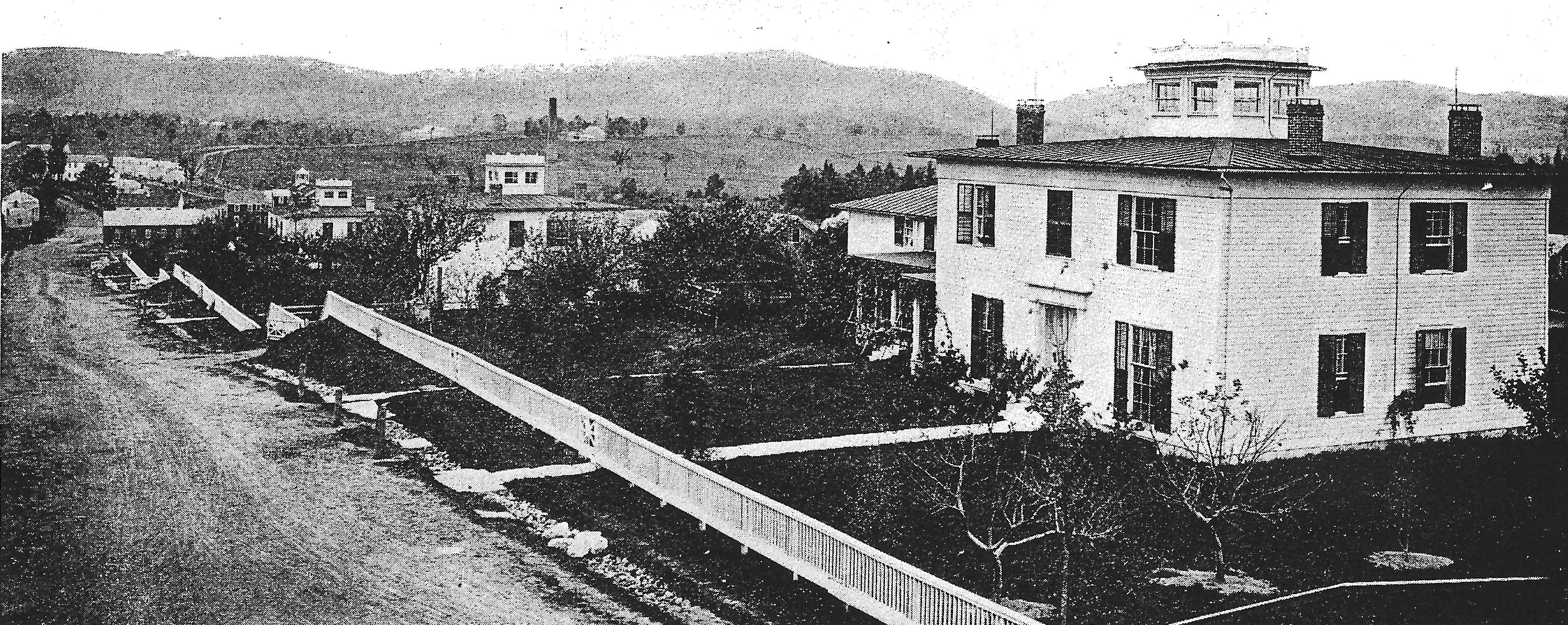
Three Villas of Barker Brothers. Mill is in Background of Middle House
Unfortunately, disaster was to strike. On January, 1879, a huge fire broke in Lower Barkerville at the Railroad Woolen Mill on Hungerford St. The building was completely destroyed and the loss also forced the other Lower Barkerville mill to close.
The closing of the two mills and national economic problems led to the eventual bankruptcy of the Barker family. By 1890 the Barkerville mill was closed and many of the homes in the area were abandoned.
Several attempts were made to reopen the mill but all failed. Finally, in 1924, the United States Bureau of Entomology of the Department of Agriculture leased the building to serve as the regional headquarters of an effort to head off the spread of Gypsy Moths that were devastating forests in the Northeast. However in 1931 the Entomology building was closed and the program relocated.
Despite several attempts to reopen the mill, all failed. Finally In 1942 the building was taken down and bricks, timbers and planking were sold to the public.
After almost 150 years, the era of mills in Barkerville had ended.
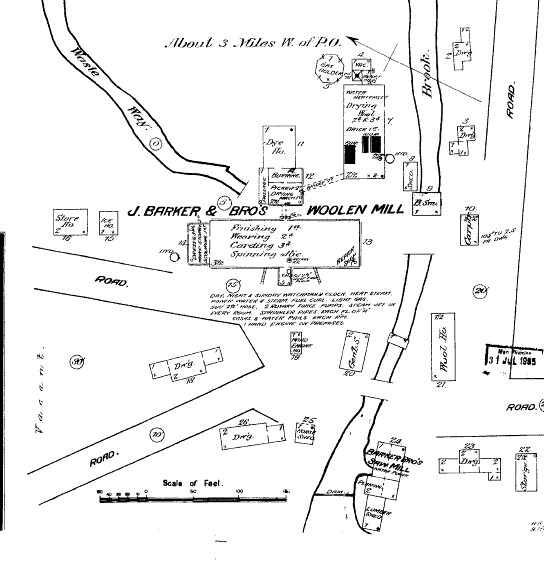
Stearnsville Mills and School
The Stearns Family were early pioneers in the development of the woolen industry in Pittsfield and Berkshire County.
The first factory at the West Pittsfield site on future Cloverdale St. was a sawmill built by Aaron Baker about 1768. In 1770 Baker sold the mill to Valentine Rathbun who converted it to a Fulling Mill for wool brought from local farms. Fulling was a process in which wool was cleaned and thickened before being made into cloth. The Pittsfield map from 1794 shows the Fulling Mill down river from Richmond Pond in the left lower section.
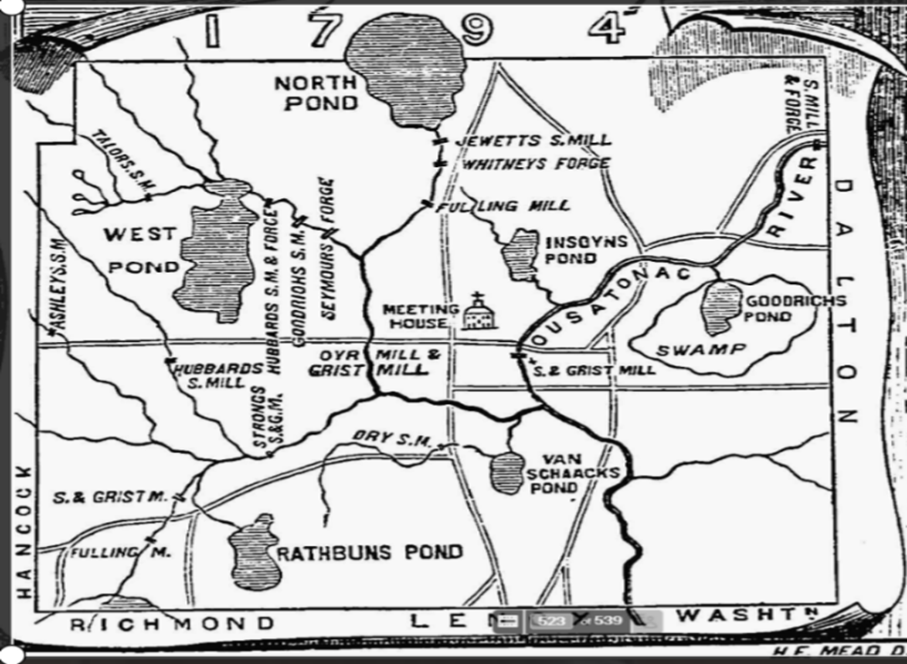
Fulling mill lower left – 1794 Map of Pittsfield Drawn by H.E. Mead in 1870
Daniel Stearns, Sr. purchased the Rathbun mill property about 1803 and expanded the production of woolen products. By 1811 he was using the revolutionary carding machines and spinning jenny built by local inventor Arthur Scholfield. In 1826 he expanded to a new mill downriver on Lebanon Avenue. That area became known as Stearnsville.
At their peak, the family owned five mills, extensive land holdings and many tenement homes for workers. However they were victims of multiple devastating fires and closed operations in the 1880’s.
The Stearnsville school was founded prior to 1845 and served the children of the mill workers. The beautiful second schoolhouse below was built in 1893 and was eventually replaced by the current school in 1961.

Lower Barkerville and the Osceola River Flouring Mill, Hungerford St.
In 1853 Daniel and Henry Stearns erected two mills on whet would be the future Hungerford St. One mill was located at the confluence with Jacoby Brook and the other at the junction with Santa Maria Place which was called the Railroad Mill. See below.
The mills were sold to the Barker family in 1865 and the area was then known as Lower Barkerville. On January 10, 1879, the Railroad Mill burned to the ground in one of the worst fires in the history of Pittsfield. Most of the buildings were destroyed and the Barkers were unable to recover after this loss.
Also in this area on Hungerford St. was the Osceola River Flouring Mill which was founded in 1865 by Charles Morgan and Fredrick Francis. The mill site later became a large planing mill used to convert logs to dimensional lumber. On October 28, 1895, a worker tipped over a lamp and started a fire that eventually spread throughout the entire complex. The local fire company worked for over 12 hours to save the building but all was lost.
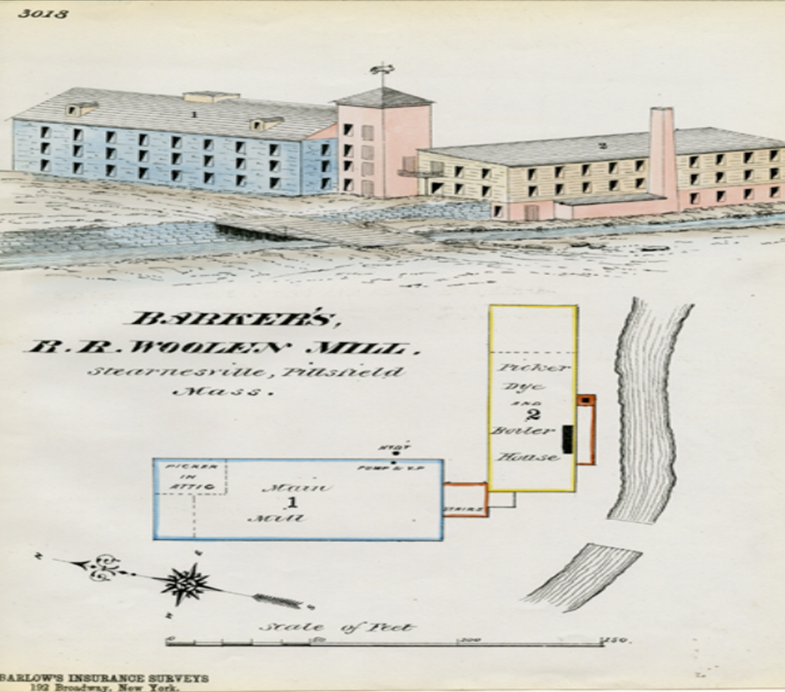
Tillotson Osceola Mill: 703 West Housatonic St.
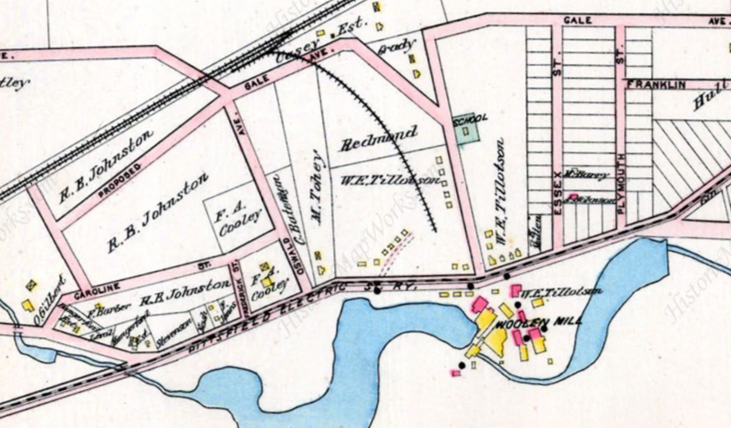
This location has a history of continuous use as a factory or business site since 1768. The first water powered sawmill in Pittsfield was said to have been built there. Later, on this site were mills for grinding plaster of Paris and a grist mill. In 1865 Otis Tillotson bought the site and founded the Osceola Woolen Mill which would remain under the Tillotson name for 66 years.
By 1904 the Tillotson Mill Village would include 140 acres, a spur to the Boston and Albany Railroad, a school, 25 homes for mill workers, a stop on the Pittsfield Electric Street Railway and the portion of land that would eventually become Osceola Park. In later years, the Lichtman Tannery, Shaeffer-Eaton, and the current Nash building and Blue Que would occupy the site.
Colt Paper Mill
His mill and the paper produced in it have long been associated with the Crane family, but the neighborhood on the border between Pittsfield and Dalton still bears his name.
Such is the fate of Coltsville, named after Thomas Colt, who bought a paper mill in 1851, converted just three years earlier from a tannery. The site had first been occupied, like other mills in the town, as an iron forge, next to the eastern branch of the Housatonic River.
Still, Thomas Colt needed more water – and clean water — to power his machinery and to turn the pulp into paper. Upstream in Dalton were the paper mills owned by Zenas Crane and his sons. So, Colt dug the first artesian well in western Massachusetts in 1856 to a depth of 250 feet. Digging through the rock and granite, Colt was able to tap into 8000 gallons of pure water every hour. In 1862, with increasing demand, Colt demolished the old building and built a two-story brick mill, measuring 100 by 50 feet with a lean-to in the rear of almost the same size. The new plant had two rag engines that turned 350 tons of rags into paper each year, employing 15 men and 30 young women. A few years later, in 1868, he added a second well, this time to a depth of 501 feet. Colt also operated a saw mill on the same water privilege.
Like many in the last half of the 19th century, fortunes were fleeting, and the Panic of 1873 hit Colt hard. On August 11, 1873, a notice appeared in the New York Times saying Thomas Colt had liabilities of $220,000 and creditors could secure his real estate against their losses. He leased the building out to another concern, who also could not make the enterprise profitable, and the building sat empty for several years.
When the Crane family secured the first government contract to print paper money, they needed to expand their operations so they bought Colt’s mill in 1879. A few years later, in 1892, a fire destroyed the original mill. With the lucrative contract to print currency, the Cranes quickly rebuilt the Government Mill that currently stands on the site of Colt’s old building.
Thomas Colt’s fortunes paralleled those of one of his brothers, Henry. The year after Thomas bought the paper mill, Henry purchased Pittsfield Woolen Mill, on the western branch of the Housatonic, and served as President until 1873, when he too was forced to sell this mill to Bel-Air Manufacturing. A third brother James followed his father into law, becoming a member of the state’s Supreme Court.
Elmwood Court, home of Edward Learned
It’s not just the mills and factories that have been lost, but also the homes for the workers and the owners.
Down the street from Park Square and near other prominent citizens and business leaders stood the expansive home of Edward Learned who was a principal investor in the Taconic and Pittsfield Woolen Mills and later served as President of Bel-Air Manufacturing. A civil engineer, Learned thought and acted grand, involving himself in spectacular ventures including silver mining on Lake Superior and constructing a trans-isthmus railway in Mexico.

Learned brought his sense for grandeur to Elmwood which he bought in 1854 from the owner of a bakery who had built it just one year earlier. The Learned family owned the house for 60 years and continued to expand with multiple outbuildings and renovations to the main home, making it one of the most spectacular residences in the city. With their 12th child born during the Civil War, the Learneds added a third story along with the curved front gable and mansard roof. The elaborate millwork of the wood railings and columns on the porches added to the decorative elements so common to Gilded Age homes.
The house was large enough to accommodate Miss Hall’s School which rented the premises following Learned’s death. The school stayed for almost ten years in the early 1900s before it moved to its present location. Gradually, the Learneds sold off parcels of the estate and by 1932, Learned’s daughter had converted the house into apartments.
Drive by the site on Bartlett Avenue, and all that can be seen is a blacktop driveway and a field. The house which had continued as apartments into the current century, burned in a frightful five-alarm blaze on May 11, 2011, depriving Pittsfield of one of its most distinctive homes.
 The Mills of Pittsfield